

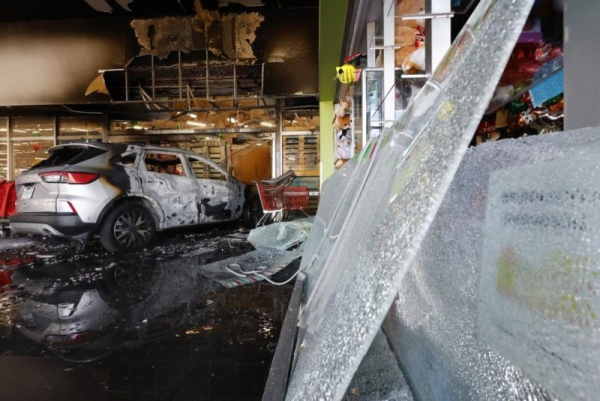
A vehicle set on fire at a shopping center by suspected members of organized crime is seen in Guadalajara, Mexico,, on Sunday after the killing of Nemesio Oseguera Cervantes, known as El Mencho, leader of the Jalisco New Generation Cartel. Photo by Francisco Guasco/EPA
The United States opened a 24-hour crisis hotline and urged Americans in several Mexican tourist destinations to shelter in place Monday after violence triggered by the killing of Jalisco New Generation Cartel leader Nemesio Oseguera Cervantes, known as “El Mencho.”
Canada issued similar warnings for areas affected by unrest and cautioned travelers about possible transportation disruptions for those seeking to leave. The United Kingdom’s Foreign and Commonwealth Office urged British citizens in Jalisco to remain indoors.
In a security alert, the U.S State Department advised Americans in areas including Jalisco, Baja California and Quintana Roo to remain in their residences or hotels, avoid areas around law enforcement activity and monitor local media for updates.
The State Department said U.S citizens calling from the US or Canada should call: +1-888-407-4747. U.S. citizens calling from overseas, including Mexico, should call: +1 202-501-4444
Airports remain open, but some domestic and international flights were canceled in Guadalajara and Puerto Vallarta as roadblocks were reported and clashes escalated in parts of the country.
Security Secretary Omar García Harfuch reported Monday that 34 suspected CJNG members were killed, including “El Tuli,” the closest logistical and financial operator to Oseguera, and that 25 National Guard personnel died during the events.
He said 85 roadblocks were reported across 11 states after the operation, along with 27 attacks against authorities, the burning of vehicles, and assaults on public and private facilities. Seventy people were arrested in seven states.
The Jalisco New Generation Cartel is one of the most powerful and violent criminal organizations in the world. Since 2010, it has rapidly expanded to establish a presence in nearly every state in Mexico and in more than 40 countries.
The group traffics methamphetamine, fentanyl and cocaine.
President Claudia Sheinbaum said Monday morning that a national command center remains active, coordinating the Armed Forces, the National Guard and state authorities to respond to any contingency. She stressed that the United States had no operational role in the mission.
“All operations are carried out by Mexican federal forces. There is no participation by U.S. forces in the operation,” she said.
“Cooperation with the United States is fundamentally based on intelligence sharing,” she added, specifying that although information was provided by Washington, “the entire operation, from its planning, is the responsibility of the Secretariat of National Defense.”
Gen. Ricardo Trevilla Trejo, secretary of National Defense, said finding the location of the cartel was the result of military intelligence tracking of his inner circle.
“On Feb. 20, through central military intelligence work, a trusted associate of one of El Mencho’s romantic partners was located,” he said. That lead pointed to a property in Tapalpa, Jalisco, where his presence was confirmed.
According to Trevilla, the initial objective was to arrest him. However, the armed group guarding him opened fire on military personnel.
“It was truly a very violent attack,” he said, describing the confrontation. El Mencho was wounded during a pursuit in a wooded area and later died during air transport, along with two bodyguards.
From Washington, White House Press Secretary Karoline Leavitt wrote on X that the United States “provided intelligence support to the Mexican government” to assist in the operation in which Oseguera “was eliminated.”
She also wrote: “Last year, President Trump rightfully designated the Jalisco New Generation Cartel as a Foreign Terrorist Organization – because that’s exactly what it is.”
The United States had been seeking Cervantes’ arrest. The State Department had offered a reward of up to $15 million for information leading to the capture of the 59-year-old.
The violence following the operation raised alerts in Central American countries over a possible reconfiguration of local criminal structures linked to the cartel.
Guatemala announced increased surveillance along its border with Mexico and stepped-up patrols in strategic areas, according to its Ministry of Defense, in coordination with Mexican authorities.
In a separate incident Friday, Guatemalan police found four suspected gang members dead inside a vehicle in Guatemala City. Authorities said the crime was linked to rivalries between the Barrio 18 and Mara Salvatrucha gangs, amid ongoing internal violence the government is addressing with reinforced security operations.
El Salvador activated its Virtual Consulate and emergency hotlines to assist Salvadorans residing in or traveling through Mexico, while Costa Rica strengthened migration controls on flights arriving from Mexico and on connecting flights to prevent the entry of individuals linked to drug trafficking.
The rise and death of “El Mencho” marked decades of influence by the Jalisco New Generation Cartel not only in Mexico, but also in strategic regions of Colombia.
The cartel established operational alliances in Colombia with the Clan del Golfo, as well as factions stemming from the former FARC and ELN guerrilla groups to secure cocaine supply.
According to reports cited by the U.S. Drug Enforcement Administration and the newspaper El Tiempo, these agreements included direct negotiation of shipments, shared use of routes and access to strategic infrastructure such as ports and corridors in Cauca and Nariño.
The cartel financed semi-submersible vessels built in Tumaco and Buenaventura and consolidated ties with the “Los Metros” faction of the Clan del Golfo to facilitate transit to Mexico and later to the United States.
After the 2016 peace agreement with Marxist guerilla organization FARC, dissident factions maintained routes and structures that allowed these operations to continue.
