

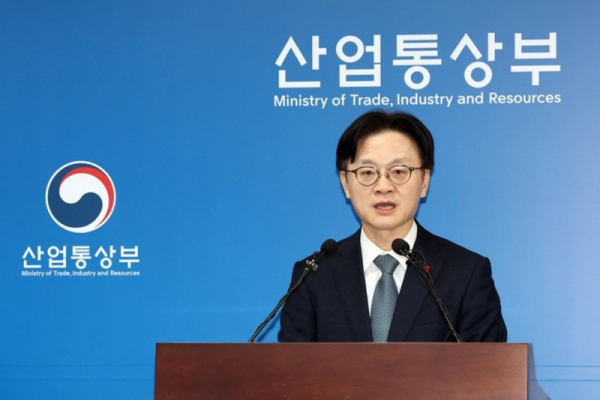
Trade, Industry and Resources Minister Kim Jung-kwan attends a press conference at the government complex in Sejong, central South Korea, 17 December 2025, to announce the ministry’s policy briefing for 2026. File. Photo by YONHAP / EPA
About 20 days after U.S. President Donald Trump announced plans to impose a 25% tariff increase on South Korean products, Seoul is accelerating its response while urging the National Assembly to move quickly on related legislation.
Although the tariff measure has not yet been published in the Federal Register, buying time for negotiations, trade uncertainty persists amid U.S. concerns over South Korea’s commitment to expand investment in the United States and calls to address non-tariff barriers.
The Ministry of Trade, Industry and Energy said it convened the first meeting of the Korea-U.S. Strategic Investment MOU Implementation Committee on Thursday to review potential U.S.-bound investment projects.
Trade Minister Kim Jeong-kwan chaired the meeting, which included officials from the Finance Ministry, Foreign Ministry and state-run financial institutions. The committee serves as a temporary mechanism to examine projects while legislation to establish a formal investment framework remains pending in the National Assembly.
Once the proposed special law on U.S. investment passes and an investment fund and consultative body are formally established, the ministry plans to transfer the committee’s discussions to the official structure.
The government’s immediate priority is to prevent publication of the tariff measure. Once published and in force, reversing it could require significant diplomatic effort and time.
Kim has said Seoul’s focus is on preventing the tariff hike itself, not merely delaying publication, adding that the two-week delay suggests U.S. authorities are taking note of South Korea’s efforts.
Experts say visible and coordinated action by both the government and the legislature will be critical to maintaining negotiating leverage.
Heo Yun, a professor at Sogang University’s Graduate School of International Studies, said the likelihood of publication is closely tied to moves by the government and the National Assembly.
However, a special parliamentary committee launched this week to handle the proposed investment legislation faced procedural disruptions on its first day, raising concerns about delays.
Heo said the government should continue proactive screening of candidate projects, feasibility studies and profitability assessments to demonstrate seriousness.
Others cautioned against overreacting to tariff threats. Kim Tae-hwang, a professor of economics and trade at Myongji University, said Washington is raising multiple issues simultaneously to increase pressure, including non-tariff barriers.
“While maintaining our basic position, we need a calm and strategic response,” Kim said. “We must avoid weakening our negotiating power through unnecessary concessions.”
Analysts also stressed the need to unify messaging through official consultation channels to ensure that Seoul’s efforts are clearly conveyed to Washington.
— Reported by Asia Today; translated by UPI
© Asia Today. Unauthorized reproduction or redistribution prohibited.
Original Korean report: https://www.asiatoday.co.kr/kn/view.php?key=20260215010005177
