

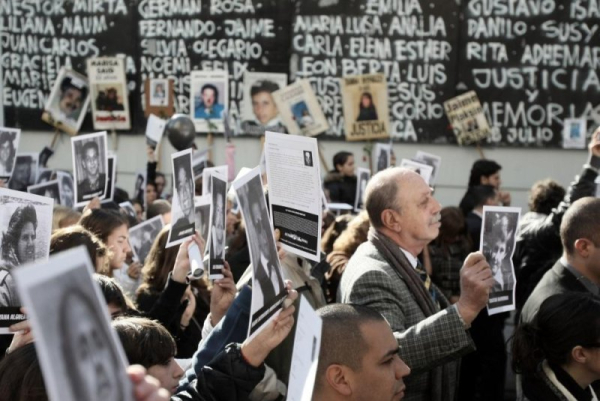
Members of the Argentinean Jewish community and relatives of the victims of the terrorist attack in 1994 against the Jewish Society facilities that caused 85 dead rally at the streets of Buenos Aires in August 2009. File Photo by Cezaro De Luca/EPA
Authorities in Paraguay and Argentina have reinforced intelligence, security and financial monitoring mechanisms in the Triple Frontier area they share with Brazil amid escalating conflict in the Middle East.
Paraguay’s Deputy Minister of Internal Security, Óscar Pereira, said the government has activated preventive measures focused on monitoring assets and terrorist activities.
“We are working on controlling illicit financing and preventing the infiltration of extremist groups,” Pereira said.
He said the actions include information sharing and intelligence analysis coordinated with national and international agencies.
The Triple Frontier region has historically been under scrutiny by international security agencies due to investigations into alleged financing networks linked to terrorist group Hezbollah.
On the operational level, Pereira said institutional mechanisms were activated to track money flows, both legal and illegal.
Among the institutions involved, he mentioned the Secretariat for the Prevention of Money or Asset Laundering (Seprelad), the National Directorate of Tax Revenues (DNIT), the National Police and other state agencies.
Pereira also highlighted the reactivation and expansion of the powers of the Tripartite Command, a cooperative mechanism between Paraguay, Argentina and Brazil that includes tasks related to combating terrorism and money laundering.
Pereira stressed that the government’s approach is preventive rather than repressive.
“We do not have a specific operation underway. We are working to prevent situations of extremism from occurring,” he said.
He also confirmed that Paraguay maintains information exchanges with international agencies and highlighted the existence of an office working in coordination with the FBI, staffed by Paraguayan police officers trained by that agency and with access to analytical tools.
In Argentina, authorities also announced preventive measures in the border region. The government raised the national security level to “high” and reinforced surveillance at locations considered sensitive.
Bruno Bladilo, president of the Posadas branch of the Delegation of Argentine Israeli Associations, said the measures are intended to anticipate possible risks amid the escalation of the conflict.
“At the moment there is no alert, there are no threats. We are simply attentive and protected by public security services,” he said in radio interviews.
Monitoring of the area is also part of measures previously adopted by Paraguay to strengthen counterterrorism cooperation with the United States.
In August, Paraguay’s interior minister, Enrique Riera, confirmed the country would establish an anti-terrorism center with support from the FBI focused on monitoring possible networks linked to Hezbollah in the Triple Frontier.
He told CNN Brasil in August that the unit would be staffed by Paraguayan agents trained by the FBI and dedicated to gathering intelligence and sharing information with regional and U.S. authorities on terrorism and organized crime.
Paraguay has designated Hezbollah as a terrorist organization, and the new center aims to strengthen international cooperation to detect possible financial structures of the group in the region, Riera said.
Also last year, the U.S. government announced a reward of up to $10 million for information leading to the identification and dismantling of Hezbollah financial networks in the border area between Argentina, Brazil and Paraguay.
Regional concerns also relate to historical precedents in Argentina linked to Iran and Hezbollah.
On July 18, 1994, a car bomb destroyed the headquarters of the Argentine Israelite Mutual Association in Buenos Aires, killing 85 people in the deadliest terrorist attack in the country’s history.
Argentina’s judicial investigation maintained that the attack was planned by senior Iranian officials and carried out by Hezbollah.
In a ruling presented in 2024, Sebastián Basso, head of the association’s Prosecutor’s Unit, said Iran’s now-deceased supreme leader, Ali Hosseini Khamenei, chaired a meeting of the Special Affairs Committee in the city of Mashhad on Aug. 14, 1993, during which the operation was approved.
Another suspect in the case is Ahmad Vahidi, recently appointed commander in chief of the Islamic Revolutionary Guard Corps, who is subject to an Interpol Red Notice for his alleged role in planning the attack. Argentina’s government under President Javier Milei requested his arrest in 2024.
An Interpol Red Notice is a global request to law‑enforcement agencies to find and temporarily detain someone so they can be extradited to the country that issued the underlying arrest warrant.
