

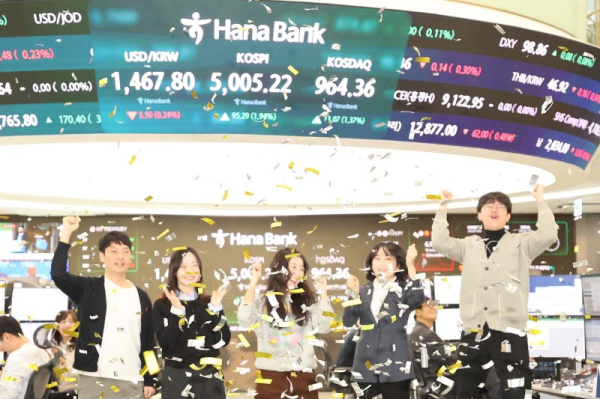
Dealers at Hana Bank celebrate at the lender’s head office in Seoul on Thursday as as South Korea’s benchmark KOSPI surpasses 5,000 points for the first time. Photo courtesy of Hana Bank
South Korea’s benchmark KOSPI nearly doubled in less than a year, crossing the 5,000-point mark for the first time in 45 years Thursday.
The KOSPI opened 1.57% higher at 4,987.06 points and quickly climbed past the 5,000-point threshold, hitting an intraday peak of 5,019.54 points.
The country’s main index, which began at 100 points in early 1980, later pared gains to close at 4,952.53 points, up 0.87% from the previous session.
When President Lee Jae Myung was inaugurated in early June last year, he pledged that the KOSPI would reach the 5,000-point milestone during his five-year term. Back then, the index was just below 2,700 points.
The commitment materialized well ahead of schedule, as the benchmark surpassed 3,000 points in late June and topped 4,000 points four months later.
The country’s three most valuable companies — Samsung Electronics, SK hynix, and Hyundai Motor — played a key role in the rally, driven by their competitiveness in the semiconductors and robotics.
The share price of Samsung Electronics has more than doubled over the past year, while SK hynix has tripled during the span. Hyundai Motor has surged up to 80% this year alone.
The three firms together make up around 40% of the total market capitalization of the KOSPI, which comprises more than 800 listed companies.
Samsung Electronics and SK hynix are the world’s two biggest memory chipmakers, for which earnings have been bolstered by the strong demand related to the AI boom.
Hyundai Motor, one of the world’s leading automakers, benefited from investor enthusiasm after showing advances in physical robotics at the Consumer Electronics Show 2026 in Las Vegas early this month.
The incumbent Lee administration has also tried to boost the stock market by encouraging listed companies to enhance shareholder returns through higher dividends, share buybacks and better corporate governance.
Market watchers remain optimistic about near-term prospects.
“The elevated share prices on the Seoul bourse are underpinned by solid corporate performances, particularly from Samsung Electronics and SK hynix,” HMC Investment Securities analyst Kim Joong-won told UPI.
“We see no signs of a bubble at this stage. Given the strong outlook of major industries such as semiconductors, the market is likely to remain strong at least in the first half of 2026,” he said.
