

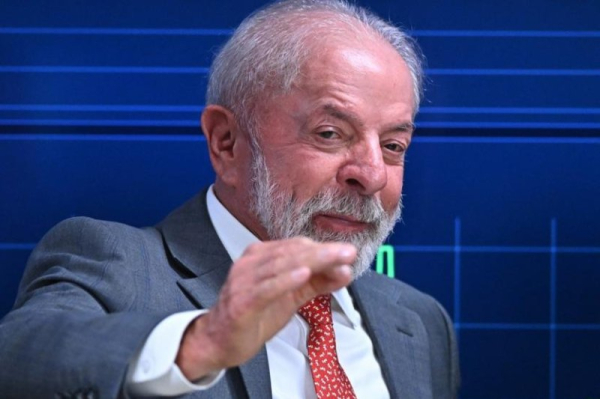
Brazilian President Luiz Inacio Lula da Silva will not attend will not attend Saturday’s signing ceremony in Paraguay for the free trade agreement between Mercosur and the European Union. Photo by Andre Borges/EPA
Brazilian President Luiz Inacio Lula da Silva will not attend Saturday’s signing ceremony in Asuncion, Paraguay, for the free trade agreement between Mercosur and the European Union — a decision that has sparked diplomatic tensions within the South American bloc.
Presidents from Argentina, Paraguay and Uruguay are expected to attend the event. Brazil will be represented by Foreign Minister Mauro Vieira.
Presidents from Panama and Bolivia will also attend as special guests. Bolivia is seeking to join Mercosur as a full member. Mercosur is the Southern Common Market formed by Argentina, Brazil, Paraguay and Uruguay.
Lula’s absence comes at a key moment for the trade agreement, considered one of the world’s largest after more than 25 years of negotiations.
On Friday in Rio de Janeiro, Lula met with European Commission President Ursula von der Leyen in a session Brazilian diplomats described as carrying greater political weight than Saturday’s ceremonial signing.
Brazil has been one of the main political backers of the deal. Lula’s decision exposed internal diplomatic strains and caused discomfort among some regional partners.
Argentine newspaper La Nacion reported that senior Argentine government officials criticized Lula’s move, saying the Brazilian leader “set up a parallel summit a day earlier,” which they described as “a lack of respect toward his partners.”
Brazilian daily O Globo reported that Lula sought a “victory photo” with top European officials to reinforce Brazil’s role as a guarantor of the agreement and to avoid Argentine President Javier Milei, with whom relations have deteriorated in recent days over sharply different positions on the Trump administration’s involvement in Venezuela.
Brazil’s government downplayed Lula’s absence, saying the signing was originally conceived as a ministerial-level event and was elevated to a presidential ceremony at the last minute by Paraguay.
Tensions also exist in Europe, where the agreement must undergo ratification in the European Parliament, a politically sensitive stage facing opposition from agricultural and environmental groups. About 150 members of the European Parliament have already signaled possible legal action or initiatives to block or delay approval.
To prevent that process from stalling implementation, the Council of the European Union is considering provisional application of chapters related to political dialogue and institutional cooperation, which do not require immediate parliamentary ratification.
That approach would allow partial advancement of the agreement’s political framework while legislative debates over the trade commitments continue.
The EU-Mercosur agreement would create a market of more than 700 million people, representing nearly a quarter of global gross domestic product. The treaty aims to eliminate or reduce tariffs on thousands of products, facilitate investment and expand access to key sectors such as industry, agriculture and services, giving it significant economic and geopolitical weight.
