

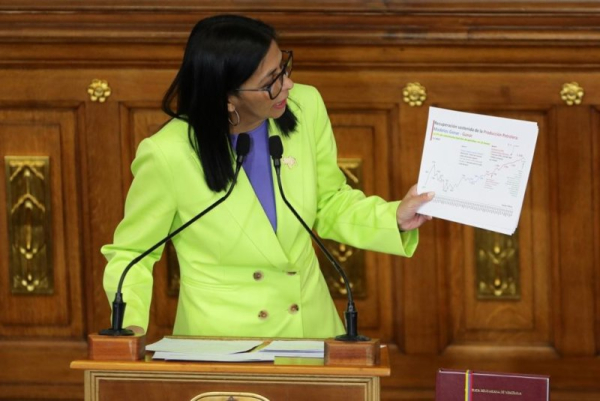
The interim president of Venezuela, Delcy Rodriguez, shows a document as she delivers Venezuelan President Nicolas Maduro’s annual report to Parliament in Caracas on Thursday. Maduro is detained in the United States along with his wife, Cilia Flores, after they were captured during a U.S. military operation January 3. Photo by Ronald Pena/EPA
The government of Venezuela Interim President Delcy Rodríguez has submitted to the National Assembly a bill to partially reform the Organic Law of Hydrocarbons, aiming to attract investment in the oil sector, particularly in fields that lack infrastructure or remain undeveloped.
Speaking during the annual address to the nation, Rodríguez presented a review of former President Nicolás Maduro’s 2025 year in office and announced social, wage and legislative initiatives.
Rodriguez assumed the interim presidency after the capture of Maduro and his wife, Cilia Flores, by U.S. forces in a predawn military operation Jan. 3.
She said the hydrocarbons reform seeks to incorporate mechanisms and production models created under the so-called Anti-Blockade Law, giving them stronger legal backing.
“We brought the hydrocarbons law reform bill to incorporate the production models that exist in the Anti-Blockade Law so that investment flows can be included and our hydrocarbons can be protected,” Rodríguez was quoted as saying by Venezuelan daily Ultimas Noticias.
She added that the changes would allow those investment flows to be applied to new fields or fields that have not been developed due to a lack of infrastructure.
The proposal comes as the administration of President Donald Trump has expressed interest in reactivating Venezuela’s oil sector and encouraging investment by major U.S. companies after years of stagnation, sanctions and legal restrictions.
Addressing lawmakers, senior military officials, representatives of Venezuela’s branches of government and relatives of Maduro including detained lawmaker Flores, Rodríguez defended the energy agreement with the Trump administration as part of what she described as Venezuela’s historic trade relationship with the United States and urged officials not to fear contradictions, according to digital outlet Efecto Cocuyo.
Current law requires state oil company PDVSA to hold a majority stake in all joint ventures with foreign partners. The reform could introduce more flexible arrangements for foreign investors, though specific details have not been disclosed.
Rodríguez also announced creation of two sovereign funds financed by oil revenues.
One fund would support social protection programs aimed at improving worker income, as well as education and health services. The other would focus on infrastructure and public services. Authorities also ordered creation of a technology platform to manage both funds, ensure transparency and prevent corruption.
The Anti-Blockade Law, approved in 2020, granted Venezuela’s executive branch extraordinary powers to bypass international sanctions, including the ability to modify or suspend laws, sign confidential agreements and loosen state control in strategic sectors such as oil to attract investment and keep the economy operating.
In practice, this law has served as an exceptional framework for implementing new business models in the hydrocarbon sector that were not foreseen in traditional legislation, which generated gaps and legal questions.
The hydrocarbons reform seeks to formally incorporate those mechanisms into ordinary law, providing greater legal certainty for investors and reducing reliance on extraordinary powers.
