

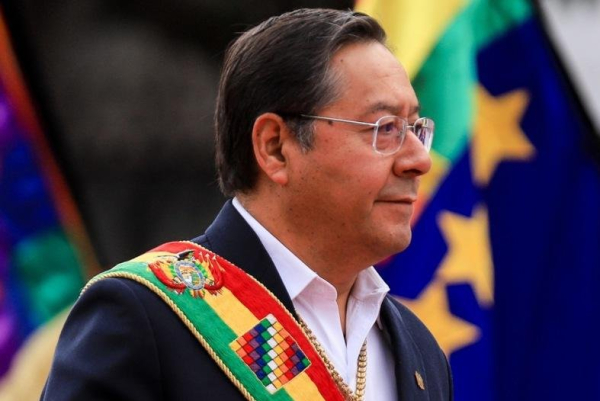
Amid a a variety of national problems, Bolivian President Luis Arce arrives at the bicentennial commemorations of the country’s independence in Sucre on Wednesday. Photo by Gabriel Marquez/EPA
Bolivia marked 200 years as a republic this week, but the atmosphere was far from festive. A deep political crisis, collapsing international reserves, shortages of fuel and U.S. dollars, and a complete rupture within the ruling party overshadowed the bicentennial celebrations.
With less than two weeks until the Aug. 17 general election, the ruling Movement for Socialism, or MAS, party — dominant for the past 20 years — lacks a unifying candidate.
Meanwhile, the opposition, led by businessman Samuel Doria Medina, has capitalized on the crisis and now leads in the polls, though his support remains under 20%.
During official celebrations on Wednesday, President Luis Arce avoided any mention of the institutional crisis facing the country and instead focused on defending his economic model. His speech sought to link Bolivia’s bicentennial with the political project MAS has promoted since 2006, rooted in the popular movement.
Arce reaffirmed the principles of a pluralistic economy, the 2006 nationalization of hydrocarbons, state control over strategic resources and the push for industrialization as essential to achieving economic independence in Bolivia.
According to a recent report by the Economic Commission for Latin America and the Caribbean, of ECLAC, Bolivia maintains an expansionary fiscal policy, but it is built on unsustainable foundations. One of them is the subsidy on hydrocarbons, which has weakened the government’s ability to respond to other social needs.
GDP growth is projected at 1.4% in 2025, with a further slowdown to 1.1% expected in 2026. “An expansion insufficient to reduce poverty, create formal employment or sustain public finances,” the report warned.
ECLAC warned that the policy “has deteriorated public accounts” and that maintaining it “severely limits fiscal space.” The problem is compounded by an economy heavily reliant on gas and minerals, with little progress in diversifying production.
“Subsidies must be urgently reviewed,” the organization said. In 2024, public spending remained high, while fiscal revenue declined due to lower natural gas output and an unfavorable international climate.
Bolivia holds one of the world’s largest lithium reserves, but production in 2024 reached only 2,000 tons — far short of the 150,000-ton goal. The industry has struggled to grow amid institutional instability, lack of transparency in international contracts and limited investment.
One of the most alarming indicators for analysts is the level of Bolivia’s net international reserves. The country ended 2024 with just $1.976 billion — only $50 million of it in liquid foreign currency.
Adding to this is growing social unrest, as sectors including transportation, agribusiness and commerce report fuel shortages, import restrictions and an economy increasingly strained by soaring food prices.
Widespread distrust in Bolivia’s electoral, judicial and oversight institutions has deepened the perception of a country adrift.
To complete the picture, former President Evo Morales — barred from running again by the Constitutional Court and lacking official party backing — called from his stronghold in the Tropic of Cochabamba for voters to cast null ballots in the Aug. 17 election.
In a message released during the bicentennial, Morales described the null ballot as a “democratic rebellion” and a referendum against what he called a “delegitimized” election, designed to favor the ruling party and preserve an “old elite democracy” that excludes the people.
His supporters, including loyal lawmakers, have opened campaign offices in regions such as Santa Cruz and claim null ballots will exceed 60%, warning: “Without Evo, there are no elections.”
