

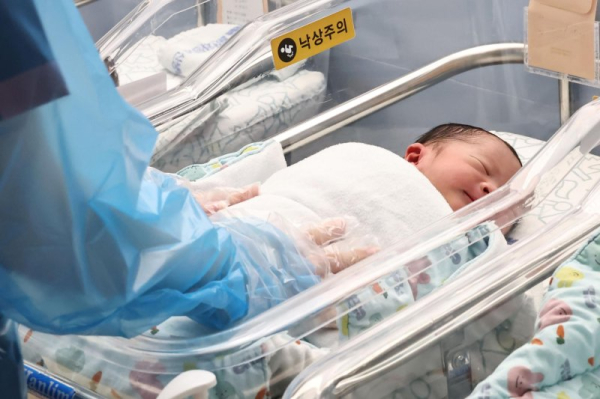
The number of babies born in South Korea rose at the fastest pace in seven years in January, government data showed Wednesday. In this file photo, a nurse cares for a newborn at a hospital in Goyang on Dec. 26, 2025. File Photo by Yonhap
The number of babies born rose at the fastest pace in seven years in January, driven largely by an increase in marriages, government data showed Wednesday.
A total of 26,916 babies were born in January, up 11.7 percent from the same period a year earlier, according to the data from the Ministry of Data and Statistics.
The January figure was the highest for the month since 2019, when 30,271 babies were born, the ministry said, noting that births are gradually recovering to pre-pandemic levels.
The number of newborns has been on an upward trend since July 2024.
The country’s total fertility rate, the average number of children a woman is expected to have in her lifetime, rose 0.1 from a year earlier to 0.99 in January.
It marked the highest rate since January 2024, when such data began being compiled on a monthly basis.
On an annual basis, the last time the fertility rate exceeded 1 was in 2017, when it stood at 1.052.
The rate then fell to a record low of 0.721 in 2023 before beginning to rebound in 2024.
However, the rate still remains well below the 2.1 births per woman needed to maintain a stable population without immigration.
The ministry said the recent rise in births appears to have been influenced by a continued increase in marriages, government policies supporting childbirth and the growth in the population of women in their early 30s.
In South Korea, where childbirth outside of marriage remains rare, an increase in marriages tends to precede a rise in births.
The number of marriages in January jumped 12.4 percent on-year to 22,640, marking the 22nd consecutive month of growth.
The figure is the highest for the month of January since 2018, when 24,370 marriages were recorded.
The number of divorces also went up 4.2 percent on-year to 7,280 in the cited month, the data showed.
Meanwhile, the number of deaths went down 17.6 percent from a year earlier to 32,454, resulting in a natural population decline of 5,539.
Copyright (c) Yonhap News Agency prohibits its content from being redistributed or reprinted without consent, and forbids the content from being learned and used by artificial intelligence systems.
