

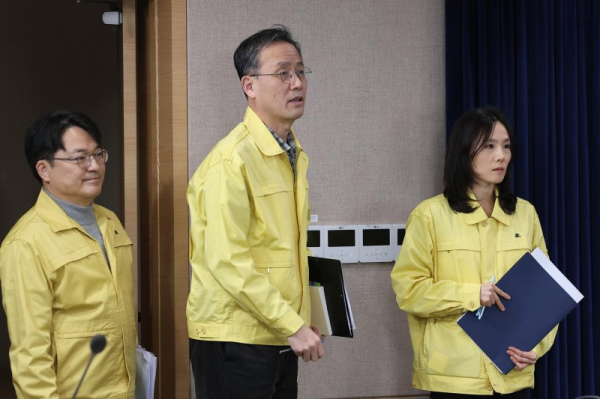
First Vice Finance Minister Lee Hyoung-il (C) and Second Vice Foreign Minister Kim Jina (R) attend an emergency government meeting on the Iran crisis held at the government complex in Seoul Tuesday. Photo by Yonhap
The government said Tuesday it will push for securing oil supplies from outside the Middle East in response to the de facto closure of the Strait of Hormuz amid ongoing U.S. and Israeli strikes on Iran, while stressing that South Korea has sufficient oil reserves.
The Ministry of Economy and Finance held an emergency response meeting on the Iran conflict with related ministries to assess the impact of the situation on South Korea and discuss a response strategy.
The ministry said no safety issues have been reported from Korean vessels operating in the Middle East and that the country holds sufficient oil reserves under a scenario in which the crisis becomes prolonged.
But in preparation for a potential full blockade of the Hormuz strait, the world’s most critical oil export route, the government will work to secure additional oil supplies from regions other than the Middle East, it added.
South Korea heavily relies on energy shipped through the strait, importing about 70.7 percent of oil and 20.4 percent of liquefied natural gas from the Middle East.
On Monday (local time), the Islamic Revolutionary Guard Corps declared the Strait of Hormuz closed and threatened to attack any ships passing through the waterway, according to Iran’s state media.
The ministry said the government will monitor domestic and global energy, and financial markets around the clock, and is ready to implement a market stabilization program, comprising at least 100 trillion won (US$68.4 billion) in support, if needed.
The benchmark Korea Composite Stock Price Index (KOSPI) plunged over 7 percent Tuesday amid heightened concerns over the Iran crisis.
International oil prices continued to show volatility, but the pace of the price hike slowed down, according to the ministry.
The government will also sternly respond to unfair market practices, including fake news operations that attempt to exploit investor sentiment, the ministry added.
Meanwhile, Vice Budget Minister Lim Ki-keun ordered ministry officials to “thoroughly” monitor the status of government budget execution related to export firms, shipping firms and overseas Korean nationals to minimize damage connected with the crisis, according to Lim’s office.
Separately, Industry Minister Kim Jung-kwan convened a meeting on the Middle East crisis and decided to roll out preemptive support measures for some 1,000 exporting firms, mainly shipping goods to the Middle East. The package includes export vouchers and liquidity support, his office said.
On the energy supply front, Kim ordered industry ministry officials to swiftly prepare for the release of oil reserves if the supply condition worsens, while working to secure alternative gas supplies from outside the Middle East.
For now, however, the impact of the Iran conflict on Korea’s energy supply, maritime logistics and supply chains remains limited, he explained.
Copyright (c) Yonhap News Agency prohibits its content from being redistributed or reprinted without consent, and forbids the content from being learned and used by artificial intelligence systems.
