

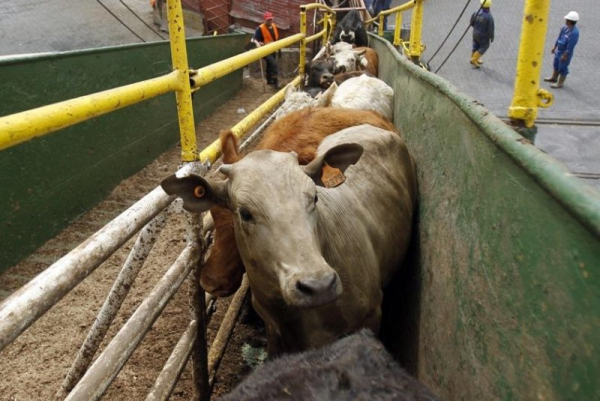
Uruguay announced emergency measures to reinforce sanitary controls and maintain confidence in beef for export after China found drug residue in a shipment. File Photo by Hugo Ortuno/EPA
China returned two containers of Uruguayan beef after detecting residue of the antiparasitic drug fluazuron, which is used to control ticks in cattle.
The incident prompted the Uruguayan government to announce emergency measures to reinforce sanitary controls and maintain confidence in its main export market.
Uruguay’s Ministry of Livestock, Agriculture and Fisheries said the contamination resulted from failure to comply with withdrawal periods, meaning the length of time that must pass between administering the medication and slaughtering the animal.
Fluazuron requires at least 42 days for residue to clear from the animal’s system, but shorter treatment cycles most likely caused the presence of the compound in the meat, officials said.
Livestock Minister Alfredo Fratti and Deputy Minister Matías Carámbula said the contaminated beef was destroyed before reaching consumers and that Chinese authorities did not impose sanctions.
However, the Chinese government notified Uruguay that it will increase sampling of Uruguayan beef arriving at its ports by 80%.
China is the primary destination for Uruguayan beef, accounting for about 60% of its meat exports. In 2024, Uruguay shipped 361,720 tons of beef as part of 681,827 tons of total meat products that generated $2.57 billion in revenue.
Uruguayan authorities announced five measures to prevent new rejections: strengthening inspections at slaughterhouses and export plants with a focus on detecting fluazuron; launching a national training campaign on the responsible use of veterinary drugs; increasing sampling at processing plants by 20%; toughening financial and administrative sanctions for producers or professionals found responsible; and establishing a national tick-control plan as a state policy.
Carámbula said on a local television program that Uruguay’s livestock traceability system allowed officials to quickly identify the farms from which the affected animals originated and suspend their shipments while the investigation continues.
Penalties may include fines of up to $2,000 and the temporary suspension of livestock deliveries for slaughter.
Carámbula said food-safety controls apply to meat destined for both export and the domestic market, and that products with residue levels above permitted limits are destroyed before they reach consumers.
So far, the incident has not caused significant economic impact, but it has raised concern within the meat sector.
“In economic terms, it was not a major impact because only two containers were rejected. But if other cases appear with residues of these products, then it could certainly become complicated,” Carámbula said.
The Uruguayan government said it maintains a relationship of trust and cooperation with China, and that the measures taken already have been formally communicated to the Chinese ambassador in Montevideo and to Chinese health authorities.
