

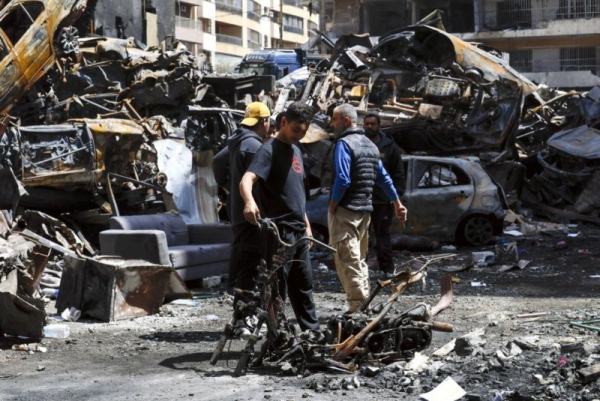
People walk Monday among the wreckage of cars in Corniche el Mazraa, one of the areas hit during a massive wave of Israeli airstrikes last week in Beirut, Lebanon, Photo by Wael Hamzeh/EPA
Divisions among Lebanese over Iran, Hezbollah and state authority have intensified amid Israel’s destructive war on the country, fueling distrust, suspicion, hatred and accusations of treason while heightening fears of sectarian violence — or worse, another civil war.
Such strong sentiments have so far remained largely confined to social media, where an intense war of words between Hezbollah’s supporters and opponents has reached an unprecedented level, with only limited incidents on the ground that have been quickly contained by security forces.
The increased tension reflects mounting discontent and growing rejection among many Lebanese of Hezbollah’s influence over the country and its role in dragging it into pointless wars they neither want nor consider to be in Lebanon’s interest.
Hezbollah’s supporters, meanwhile, have become more defiant in displaying their group’s power and allegiance to Iran, refusing to surrender their weapons or submit fully to state authority.
It was, in fact, a struggle that has been developing over the past years between those who want Lebanon to be governed solely by the state, with the exclusive authority over decisions of war and peace and protection provided by the army, and those who strongly support Hezbollah and Iran, viewing them as essential for their security against Israeli threats.
This divide has increasingly taken on a sectarian dimension, often pitting many Christians and Sunnis against much of the Shiite community.
The breaking points came when Hezbollah decided to open a support front for Gaza on October 8, 2023, and more recently became involved in the U.S.-led war on Iran, firing missiles on Israel, to avenge the killing of Iran’s Supreme Leader, Ayatollah Ali Khamenei, and respond to continued Israeli attacks on Lebanon.
Both wars proved devastating for Lebanon, already mired in crisis, as they triggered harsh and widespread Israeli retaliation, resulting in high casualties, large-scale displacement, extensive destruction and a weakening of Hezbollah.
The militant party — whose military and security activities were recently outlawed by the Lebanese Cabinet — and its Shiite community bore the brunt of these wars. They were specifically targeted by Israel’s intensive airstrikes, forced displacement, the destruction of homes and flattening of villages in southern Lebanon.
Estimates indicate that, since October 2023, some 6,560 people have been killed and more than 23,000 wounded. The number of displaced has reached 1.2 million, while total war losses have exceeded $15 billion.
The new massive displacement — the second in less than 30 months — has triggered again a widespread humanitarian response and strong sympathy for the displaced, with hosting communities across Lebanon rushing to provide shelter and supplies, putting aside political differences.
However, tensions and suspicion could not be concealed, particularly as Israel began to strike apartments and hotels in previously considered safe areas, reportedly targeting Hezbollah members and Islamic Revolutionary Guard Corps operatives hiding there — and endangering civilian lives and host communities.
Such attacks took a tragic turn Wednesday, when Israel conducted about 100 strikes that targeted residential buildings in the heart of Beirut and across Lebanon, killing at least 357 people and injuring 1,223 in a single day.
While Israel claimed that 300 Hezbollah members were among the dead, reports indicate that the majority of those killed were civilians, including entire families.
David Wood, a senior Lebanon analyst at the International Crisis Group, noted that domestic tensions “are worsening,” as Israel has not only displaced approximately 1 in 5 Lebanese, but also has heightened fear and concern by regularly striking communities that host displaced Shiite populations.
“This has led to increased criticism of Hezbollah and to communities asking displaced people to leave for fear of coming under attack from Israel,” Wood told UPI, adding that Israel is not only targeting Hezbollah but also exacting “a disastrous toll on the Shiite community as a whole and on the Lebanese in general.”
He called for Israel to “stop using collective punishment in this war” and to stop giving displaced people “no real options of anywhere to go.”
Containing communal tensions became the top priority of Lebanese security forces, which increased their patrols in Beirut and other areas with large concentrations of displaced people.
The move was intended to reassure both the displaced and their hosts and to defuse tensions, according to a security source, who dismissed as “exaggerated” reports circulating on social media about weapons being found in displacement shelters or preparations for confrontation and armed clashes.
“We are firm and confident as we are ready to impose security and contain any incident,” he told UPI, noting that in times of war and crisis, people tend to exaggerate events, especially now with social media.
The first real test came Saturday, when hundreds of Hezbollah supporters took to the streets in downtown Beirut, gathering near the Government Palace, where they denounced Prime Minister Nawaf Salam, a Sunni, and called him “a Zionist” for endorsing direct talks with Israel.
The protesters, many of them on motorcycles, also toured the city chanting “Shia, Shia,” prompting Sunni groups to warn that they would mobilize in support of Salam.
After strong warnings from senior officials and the Lebanese Army, Hezbollah and its main Shiite ally, the Amal Movement, quickly issued a statement prohibiting any such demonstrations.
Lebanese people’s utmost fear is the possible outbreak of another civil war; similar to the one that devastated the country from 1975 to 1990, with its repercussions still unresolved.
Monday not only marked 51 years since the outbreak of the civil strife, but also served as a reminder of what Lebanon could face if such a conflict were to happen again.
So far, digital platforms appear to be “a safer” tool, allowing people to express fear, resentment, humiliation and anger instantly, often before facts are verified, according to Ayman Mhanna, executive director of the Samir Kassir Foundation, a civic organization promoting freedom of expression.
“People are posting rather than physically attacking one another. But that should not be mistaken for harmlessness,” Mhanna said in an interview with UPI.
He said online speech can normalize dehumanization, expand the boundaries of acceptable hostility and lay the groundwork for offline acts, especially in a country with a long history of unresolved sectarian conflict.
He warned that multiple forms of hate are circulating at once from different directions, stressing that “one hateful campaign, whatever its source, is already one too many.”
Mhanna said hostility toward Hezbollah often goes beyond criticism of its military role, political choices or regional alignment, turning into “broader sectarian language that targets Shiites as a community or assigns collective blame to civilians seen as part of its social environment.”
On the other hand, he said, pro-Hezbollah rhetoric also “fuels hate in highly dangerous ways,” especially through accusations of “treason, collaboration and betrayal” directed at political opponents, critical journalists and entire segments of Lebanese society.
“Accusations of treason are especially widespread, as are insinuations that critics will have to ‘pay the price’ after the war,” he said.
However, the scale of the national crisis, the risk of unwanted civil strife, reliance on the Lebanese army and security forces to preserve civil peace, and, most importantly, public exhaustion have so far curbed violence on the ground.
