

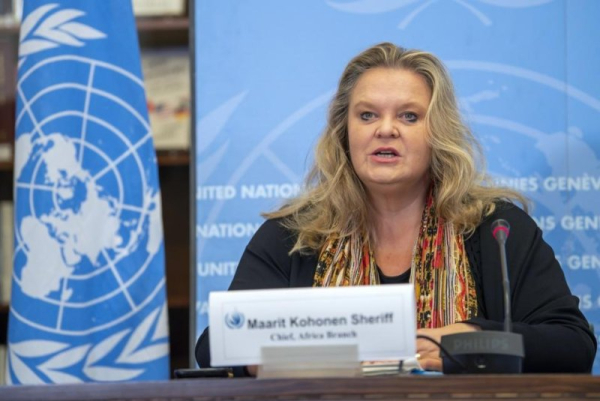
Maarit Kohonen Sheriff, director of the U.N. Human Rights Office’s Division of Global Operations, said the human rights situation in Nicaragua has significantly deteriorated over the past year. File Photo by Martial Trezzini/EPA-EFE
Nicaragua faces a widespread and intensifying political crackdown under President Daniel Ortega, as international organizations report that the persecution now extends beyond the country’s borders through killings, threats and surveillance targeting exiled dissidents.
“The persecution of individuals perceived as political opponents in Nicaragua not only continues, but has become a recurring practice that extends beyond national borders, putting exiles at serious risk of death and physical harm,” the U.N. Office of the High Commissioner for Human Rights said in a recent report.
The June 19 killing of retired Nicaraguan Army Maj. Roberto Samcam in San José, Costa Rica, is among the recent cases cited by the United Nations.
Samcam had been living in exile in Costa Rica since 2018 after accusing Ortega’s government of human rights violations. Costa Rica’s Judicial Investigation Agency said his killing may be linked to Sandinista cells operating in the country.
The agency reported that at least 137 Nicaraguan dissidents living in exile in Costa Rica have been killed or violently attacked over the past two years.
Maarit Kohonen Sheriff, director of the U.N. Human Rights Office’s Division of Global Operations, said the human rights situation in Nicaragua has significantly deteriorated over the past year.
She said those targeted include human rights defenders, journalists, Indigenous and Afro-descendant communities, and both religious and lay leaders.
In its May 2025 annual report, the Inter-American Commission on Human Rights warned of Nicaragua’s continued backsliding on human rights, the erosion of judicial independence and escalating attacks on democratic freedoms.
The report cited a pattern of targeted criminalization of political opponents both inside the country and in exile, including the revocation of legal status, arrest warrants, de facto statelessness and vague laws to suppress dissent.
The rights of Indigenous and Afro-descendant communities are also under threat, said Kohonen Sheriff, after the approval of a presidential decree eliminating public consultation for natural resource exploitation in protected areas — many situated on Indigenous and Afro-descendant lands. Attacks on these communities continue, including killings, sexual violence and arbitrary detentions.
According to a United Nations report, at least 54 people remain in arbitrary detention, including 10 Indigenous individuals.
“Arbitrary detentions continue to be used as a tool of political repression, reinforcing a climate of fear to silence critical voices,” Kohonen Sheriff said.
