

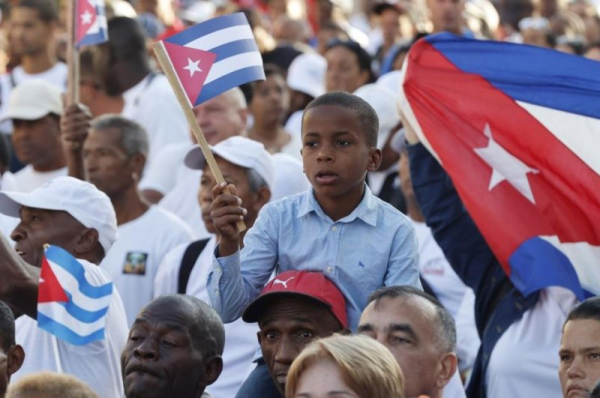
Despite energy and food shortages, residents participate in the commemoration of the 65th anniversary of the proclamation of the socialist character of the Cuban Revolution, in Havana on Thursday. Photo by Ernesto Mastrascusa/EPA
The Russian tanker Universal, linked to the so-called “shadow fleet,” was detected sailing in the North Atlantic heading west toward Cuba, according to maritime tracking platforms.
The vessel is owned by Sovcomflot, the same company that operates the Anatoly Kolodkin, which arrived in Cuba on March 31 with about 730,000 barrels of crude. A U.S. embargo and sanctions on the tanker were not enforced.
The Russian shadow fleet is a network of older, lightly regulated tankers that often move Russian oil covertly by using tactics like Automatic Identification System spoofing, shell companies and opaque ownership to evade Western sanctions.
The Universal departed in early April from a port in the Baltic Sea, and on April 8 was transiting the English Channel.
The Universal was not traveling alone, at least initially. The Russian frigate Admiral Grigorovich, part of the Black Sea Fleet, escorted the oil tanker Universal during its transit through the English Channel, along with another sanctioned tanker, the Enigma.
The operation took place shortly after United Kingdom Prime Minister Keir Starmer authorized British forces to detain sanctioned vessels in territorial waters.
During the transit, the ships were shadowed by the British logistics vessel RFA Tideforce..
EXCLUSIVE PHOTO
The sanctioned tanker UNIVERSAL (IMO 9384306) was recently spotted at sea and is now transiting westbound toward Cuba.
Earlier this month, the vessel was observed operating in proximity to Russian naval units, including SOOBRAZITELNIY and… pic.twitter.com/wenw2kXLcc— Russian Forces Spotter (@TiaFarris10) April 15, 2026
“A Russian vessel broke the blockade; a second is being loaded at this moment. We will not leave the Cuban people in difficulty,” Sergei Tsivilev, Russia’s energy minister, said April 2 during an International Electric Power Forum in Kazan.
On Wednesday, Russian Foreign Minister Sergey Lavrov reiterated Russian and Chinese solidarity with the island nation.
Speaking from Beijing after meetings with Chinese Foreign Minister Wang Yi and President Xi Jinping, he addressed the press regarding a new oil shipment and President Donald Trump.
“We have sent the first tanker with 100,000 tons [700,000 barrels] of oil to Cuba. Of course, this will probably last a couple of months. I have no doubt that we will continue providing assistance,” he told reporters.
Regarding possible actions by the Trump administration to halt the shipment, Lavrov said he hopes the United States will not return to the times of “colonial wars,” according to Cibercuba.
He added that Russia will continue to provide assistance, and that China “will also participate in this cooperation” to help ease Cuba’s energy crisis.
The country requires between 90,000 and 110,000 barrels of oil per day, but produces about 40,000, forcing it to rely on imports. Experts estimate that the shipment received at the end of March would cover only between seven and 10 days of need.
However, recent reports point to limitations in processing capacity.
According to the independent Cuban media outlet 14ymedio, the Ñico López refinery in Havana shows no visible activity after the arrival of Russian crude, with its chimney inactive and no movement of tanker trucks in the area.
The report notes that no oil transfers have been recorded from Matanzas to the capital, suggesting that part of the shipment may have been redirected to other facilities, such as the Cienfuegos refinery.
According to the same media outlet, Cuban specialist Jorge Piñón of the University of Texas suspects the plant “may be inoperable as a result of a technical problem or lack reliable and uninterrupted electricity to operate.”
Refineries, he said, “burn oil for high-temperature heating and steam; however, they depend on electricity to power essential equipment such as pumps, compressors, fans and automation systems.”
Electricity also “powers critical safety systems, sensors and pumps that transport fluids during the refining process.”
He said the situation may be linked to the fire that struck the facility Feb. 13, and “damage to logistics has not been repaired.”
From within the island, independent journalists and residents report that there is no visible impact from the arrival of fuel or humanitarian aid sent by several countries.
“Electric generation is the same or worse than before the shipment. Fuel has been processed, according to authorities, but there are no visible results in transportation, agriculture and even less in health,” Owen, an independent reporter from the digital publication Árbol Invertido, told UPI.
Owen, who is using a pseudonym for safety reasons, said that based on residents’ perceptions, some of the fuel may have been redirected to reserves controlled by the armed forces and the Interior Ministry, mainly for transporting officials and use in police vehicles and state operations.
