

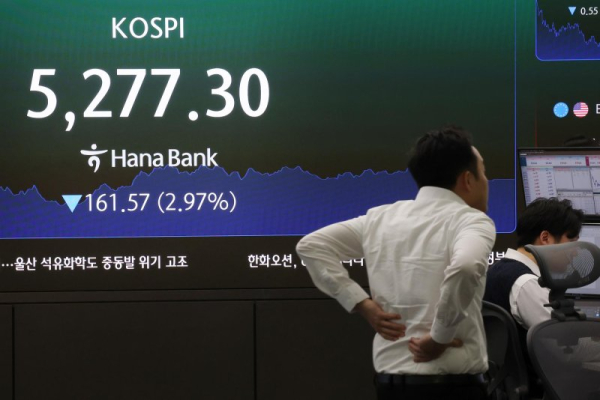
The benchmark Korea Composite Stock Price Index (KOSPI) fell 161.57 points, or 2.97 percent, to 5,277.3 Monday amid the intensifying conflict in Iran. This photo shows the trading room at Hana Bank in Seoul as the market closed. Photo by Yonhap
Seoul stocks fell nearly 3 percent Monday, led by heavy foreign selling, as an intensifying conflict surrounding Iran deepened concerns about global oil supplies and market uncertainties. The Korean won weakened against the U.S. dollar.
The benchmark Korea Composite Stock Price Index (KOSPI) fell 161.57 points, or 2.97 percent, to 5,277.3, extending the losing streak to a third session.
Trade volume was moderate at 721.04 million shares worth 20.66 trillion won (US$13.64 billion), with losers outnumbering winners 749 to 154.
Foreigners sold a net 2.13 trillion won worth of shares, while institutional and retail investors purchased a net 883.16 billion won and 897.35 billion won worth of shares, respectively.
The index opened nearly 5 percent lower Monday before paring some of its earlier losses on buying by retail and institutional investors.
Risk-off sentiment intensified as the war in the Middle East showed signs of further escalation, with the Houthis launching their first attacks on Israel since the conflict began in late February and warning of continued military operations until attacks on Iran stop.
The involvement of the Houthis poses a fresh risk to global oil markets, as concerns over further supply disruptions have risen over whether they will target vessels in the Red Sea, a crucial route for global oil and liquefied natural gas (LNG) shipments.
U.S. President Donald Trump said negotiations with Iran to end the war are going smoothly, while Washington has ordered thousands of troops to the region.
Global oil prices have already risen markedly as the Strait of Hormuz has effectively been closed, disrupting global oil supplies. South Korea depends heavily on imports for energy.
“The prolonged war is making it increasingly difficult for market participants to respond amid mixed messages and complicated developments,” Han Ji-young, an analyst at Kiwoom Securities, said. “While downside resilience in the market remains valid, investors should brace for heightened volatility.”
Losses were broad-based and deep.
Market bellwether Samsung Electronics retreated 1.89 percent to 176,300 won, while its chipmaking rival SK hynix dipped 5.31 percent to 873,000 won.
Top automaker Hyundai Motor dropped 5.15 percent to 469,500 won, while its sister affiliate Kia tumbled 2.76 percent to 151,500 won.
Bio giant Samsung Biologics decreased 4.73 percent to 1,535,000 won, and Celltrion went down 2.18 percent to 201,500 won.
Defense giant Hanwha Aerospace fell 2.02 percent to 1,308,000 won, and nuclear power plant builder Doosan Enerbility sank 3.98 percent to 94,200 won.
Leading shipbuilder HD Hyundai Heavy lost 3.71 percent to 480,000 won, while its rival Hanwha Ocean shed 4.06 percent to 118,200 won.
Major financial group KB Financial fell 4.14 percent to 145,900 won.
But leading battery maker LG Energy Solution jumped 3.93 percent to 410,000 won.
The local currency was quoted at 1,515.7 won against the U.S. dollar as of 3:30 p.m., down 6.8 won from the previous session.
Bond prices, which move inversely to yields, closed higher. The yield on three-year Treasurys fell 4 basis points to 3.542 percent, while the return on the benchmark five-year government bonds shed 4.2 basis points to 3.796 percent.
Copyright (c) Yonhap News Agency prohibits its content from being redistributed or reprinted without consent, and forbids the content from being learned and used by artificial intelligence systems.
