

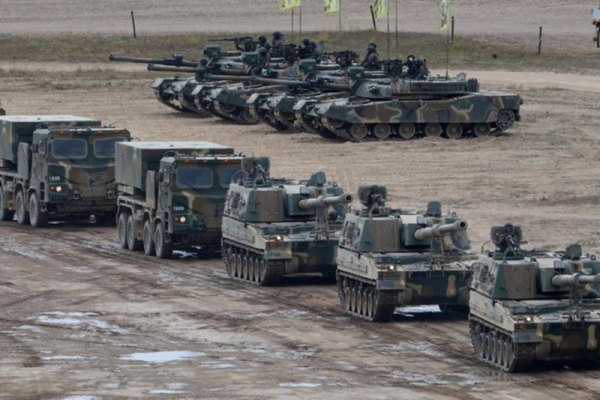
South Korean-made K1E1 tanks (background R), K9 howitzers (front) and Chunmoo multiple rocket launchers (L) are on standby for an integrated field maneuver at the training field of the Army’s 17th Division in Incheon, 27 kilometers west of Seoul, South Korea. File. Photo by YONHAP / EPA
South Korea’s K9 self-propelled howitzer is gaining traction in Europe, with Finland signing a government-to-government deal to purchase 112 additional units, bringing its total planned force to 208.
The contract is valued at about 546.8 million euros, or roughly 940 billion won ($630 million). With the latest order, Finland joins Türkiye and Poland as one of three NATO members operating more than 200 K9 systems.
The deal highlights the growing presence of the K9 in Europe’s defense market, where demand for artillery has surged following Russia’s invasion of Ukraine. Analysts say the K9 is emerging as a leading platform in the region, driven by its cost efficiency, reliability and fast delivery timelines.
Across Europe, K9 systems have been ordered or deployed by Poland, Türkiye, Finland, Norway, Estonia and Romania. Combined, those countries account for more than 1,300 units in operation or under contract. Globally, exports of the K9 have exceeded 1,500 units to more than 10 countries, according to manufacturer Hanwha Aerospace.
Poland has signed contracts for up to 672 units, including locally produced variants, while Türkiye operates more than 350 units under license production. Norway, Estonia and Romania have also expanded their fleets through repeat orders and follow-on contracts.
Defense officials and analysts say one key advantage of the K9 is interoperability within NATO. Countries using the 155mm/52-caliber system can more easily share ammunition, maintenance systems and training programs, strengthening joint operational capabilities.
The K9’s performance in extreme conditions has also been a major selling point. Nordic countries, including Finland and Norway, have highlighted its ability to operate reliably in subzero temperatures, where equipment durability is critical.
In comparisons with Germany’s PzH2000, analysts point to differences in operational balance. While the German system offers strong burst firepower and protection, concerns have been raised about maintenance demands under sustained combat conditions. The K9, by contrast, is viewed as offering a more balanced combination of performance, cost and ease of operation.
Price and delivery speed have also played a role. Industry estimates suggest that the cost of one PzH2000 could cover more than two K9 systems along with ammunition and support. Hanwha Aerospace has also emphasized its ability to deliver large volumes within months, compared with longer production timelines in Europe.
As more countries adopt the K9, a regional network of operators is taking shape across Northern and Eastern Europe, particularly along areas bordering Russia. Analysts say this trend reflects a broader shift in the global artillery market, where immediate deployability and sustainment capabilities have become increasingly important.
Hanwha Aerospace said the K9 is evolving beyond a single weapons system into a broader artillery platform, especially when paired with the K10 ammunition resupply vehicle and future upgrades such as the K9A2 and K9A3.
— Reported by Asia Today; translated by UPI
© Asia Today. Unauthorized reproduction or redistribution prohibited.
Original Korean report: https://www.asiatoday.co.kr/kn/view.php?key=20260414010004208
