

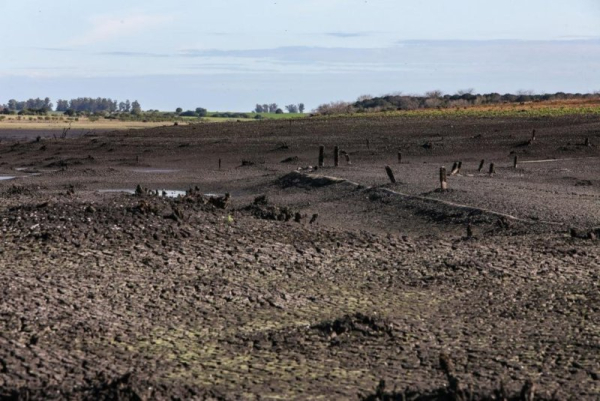
The Paso Severino reservoir was affected by the drought, in Canelones, Uruguay, in July 2023. Uruguay is going through another water crisis, as well an outbreak of avian flu. File Photo by Gaston Britos/EPA
Uruguay declared an agricultural emergency due to water shortages in productive areas. It also activated a health emergency over H5 avian influenza after the virus was found in wildlife. The dual crisis is pressuring a key export sector.
The Ministry of Livestock, Agriculture and Fisheries declared the agricultural emergency for 90 days after technical indicators of water availability worsened for livestock, dairy, agriculture and horticulture in roughly one-third of the country.
“One rainfall does not determine or correct what has been accumulating for months,” Livestock Minister Alfredo Fratti warned, explaining that the decision responds to confirmation of a persistent water deficit that is depleting reserves and affecting agricultural production.
A new evaluation will be made next week, and Fratti did not rule out incorporating additional areas into the agricultural emergency zone.
Meanwhile, the ministry declared a nationwide health emergency after detecting the H5 avian influenza virus in wild birds in the departments of Maldonado, Rocha and Canelones. Authorities imposed restrictions on the movement of backyard birds and suspended fairs, auctions and exhibitions linked to the sector as a preventive measure.
The official resolution calls for epidemiological surveillance and biosecurity measures.
Uruguay was one of the South American countries that reached a record high in exports in 2025, with $13.49 billion, driven by a recovery in the agro-export sector, including products such as beef, soybeans and dairy.
Beef consolidated its position as the main export product with sales of $2.68 billion, accounting for nearly 20% of the total. The United States is among the main markets.
China remained the main destination for Uruguay’s overall exports, accounting for approximately 26% of the total, followed by Brazil, the European Union and the United States, according to the 2025 Annual Foreign Trade Report by Uruguay XXI.
Uruguay previously faced one of its most severe droughts in decades between late 2022 and 2023, when more than 60% of the country experienced extreme or severe drought conditions, prompting the government to declare a national agricultural emergency in October 2022.
