

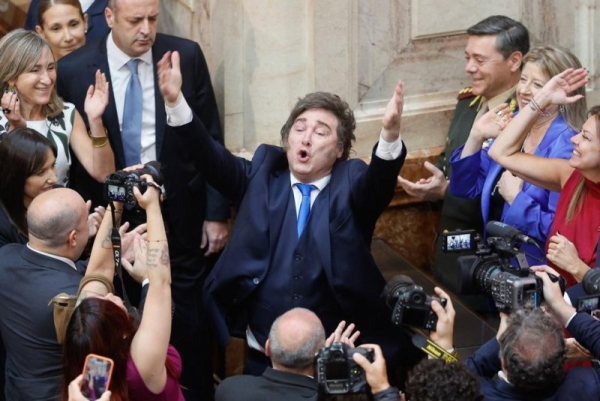
Argentinian President Javier Milei reacts during the opening of the 144th Ordinary Session of the National Congress in Buenos Aires, on Sunday. Milei addressed the nation on key initiatives for his administration. Photo by Ignacio Roncoroni/EPA
Argentine President Javier Milei opened the new legislative year with a speech focused on the reforms his government has managed to pass in recent weeks and on his relationship with President Donald Trump.
From the outset of his address, broadcast nationwide Sunday night, Milei drew a contrast between the past and the present. He said he inherited a country on the brink of collapse, with high inflation, rising poverty and an oversized state, but that has changed.
“Today, we are doing things that have been pending for decades. Today we have not only stopped feeling like losers, but we also know that we can make Argentina great again,” he said.
Before the formal opening of the legislative year, the president called extraordinary sessions. During that period, legislators approved labor reform, gave a green light to the Mercosur-EU agreement, amended the juvenile criminal law and made progress on a new glaciers law, which must still be reviewed in the Chamber of Deputies.
“It has been one of the most productive extraordinary session periods in our history,” Milei said.
Using a confrontational tone and laden with insults against the opposition, Milei used the occasion to review what he considers his main achievements in nearly two years in office and defended private property as the “cornerstone of the entire economy.”
He highlighted the approval of the first budget without a fiscal deficit and the end of money printing to finance public spending — a practice that, he explained, fueled inflation that hit vulnerable sectors the hardest.
On investment, he underscored the approval of the Incentive Regime for Large Investments, known as RIGI. According to his account, projects worth $25 billion have already been approved and others worth $45 billion are under evaluation. He said there are 32 initiatives spread across 11 provinces, with more than 60,000 direct and indirect jobs projected.
At the same time, Milei made repeated references to relations with the United States. He emphasized the trade agreement recently signed and described that country as a key ally. And he said Donald Trump’s administration came to Argentina’s aid in the face of attempts at political destabilization.
“We are building a lasting strategic alliance with the United States of America. This is not just an agreement between President Trump and President Milei. It has to do with cultural affinity and shared strategic objectives between the two countries,” he said.
According to his explanation, that relationship made it possible to renegotiate with the International Monetary Fund, overcome exchange rate tensions and attract investment.
“It is time to make this a state policy. We have to create the century of the Americas: Make the Americas Great Again, from Alaska to Tierra del Fuego,” he added.
Looking ahead, he announced that his administration will send “a package of 10 bills” for nine consecutive months to promote structural reforms that, in his words, will redesign the country’s institutional architecture.
Among the areas mentioned were changes to the Civil and Commercial Code, the Procedural Code, the tax system and the Customs Code, as well as a new legal framework for the development of natural resources.
For Cristian Buttié, director of CB Consultora, the message laid out a new doctrine for Argentina.
“[Milei] sees the United States as the protagonist and reinforces a Western orientation. He proposes that the country become a supplier of energy, minerals and food,” he told UPI.
However, he cited few concrete announcements on the economic front and said the speech fell short of expectations.
In the same vein, political analyst Lucas Romero, director of the consultancy Sinopsis, told UPI the speech took place in a different political context from the early years of the administration. He recalled that Milei took office with significant weakness in Congress and difficulty gathering support.
“Six months ago, it was hard for him to muster a third of the Chamber of Deputies to resist initiatives against him. Today, he is able to pass laws with considerable ease,” Romero said.
He added that this new balance of power explains the announcement of a scheme of “permanent reformism.”
According to his analysis, the president is trying to respond to the strong demand for change that brought him to power in 2023. During the early years, the lack of legislative support limited that agenda. Now, with greater capacity to pass laws, he is seeking to accelerate the pace.
